Outlier Detection Strategies for Reliable Banker Identification in Football Matches
Written by Lars Schmitt · Jul 27, 2026
Outlier Detection Strategies for Reliable Banker Identification in Football Matches
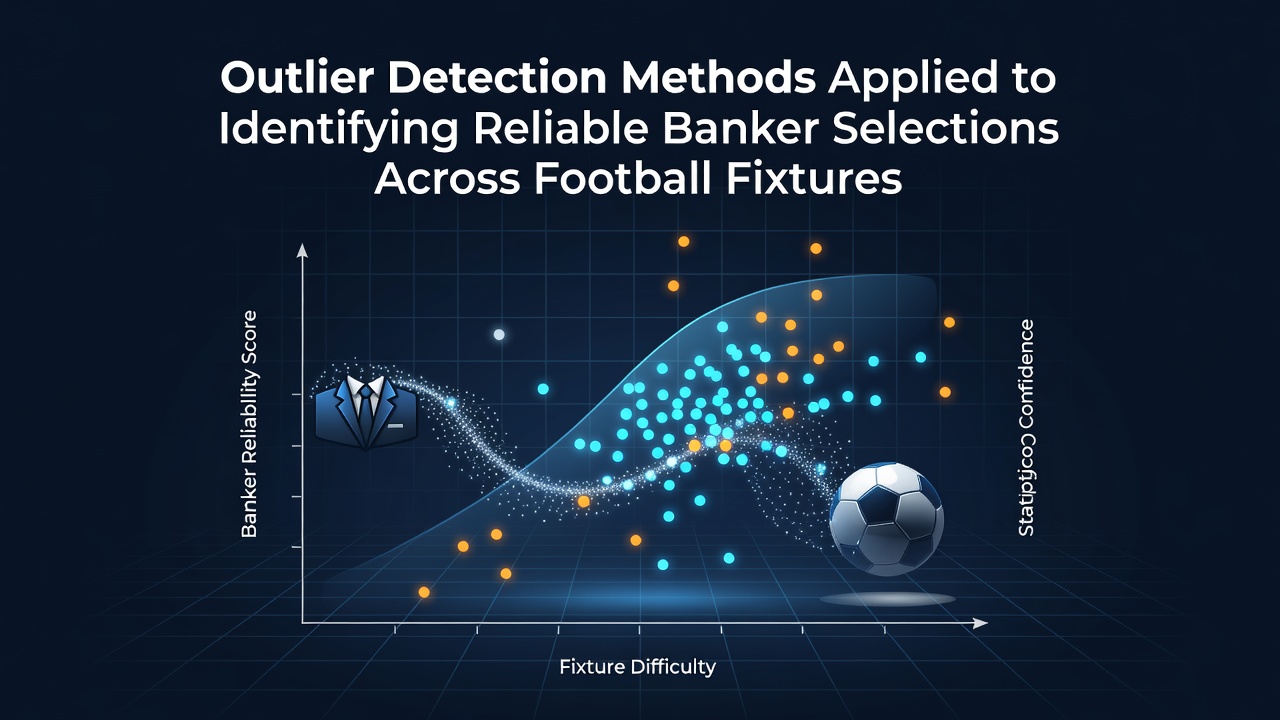
Outlier detection methods have gained traction among analysts who examine football fixtures to isolate dependable banker selections, those outcomes that demonstrate consistent patterns across large datasets. Researchers apply statistical techniques and machine learning models to flag anomalies in team performance metrics, head-to-head records, and situational variables, then use those flags to refine selections that show low variance over multiple seasons. Data from major European leagues in July 2026 indicates continued growth in the volume of matches tracked through automated systems, which allows for more granular identification of reliable banker candidates.
Core Statistical Approaches in Outlier Identification
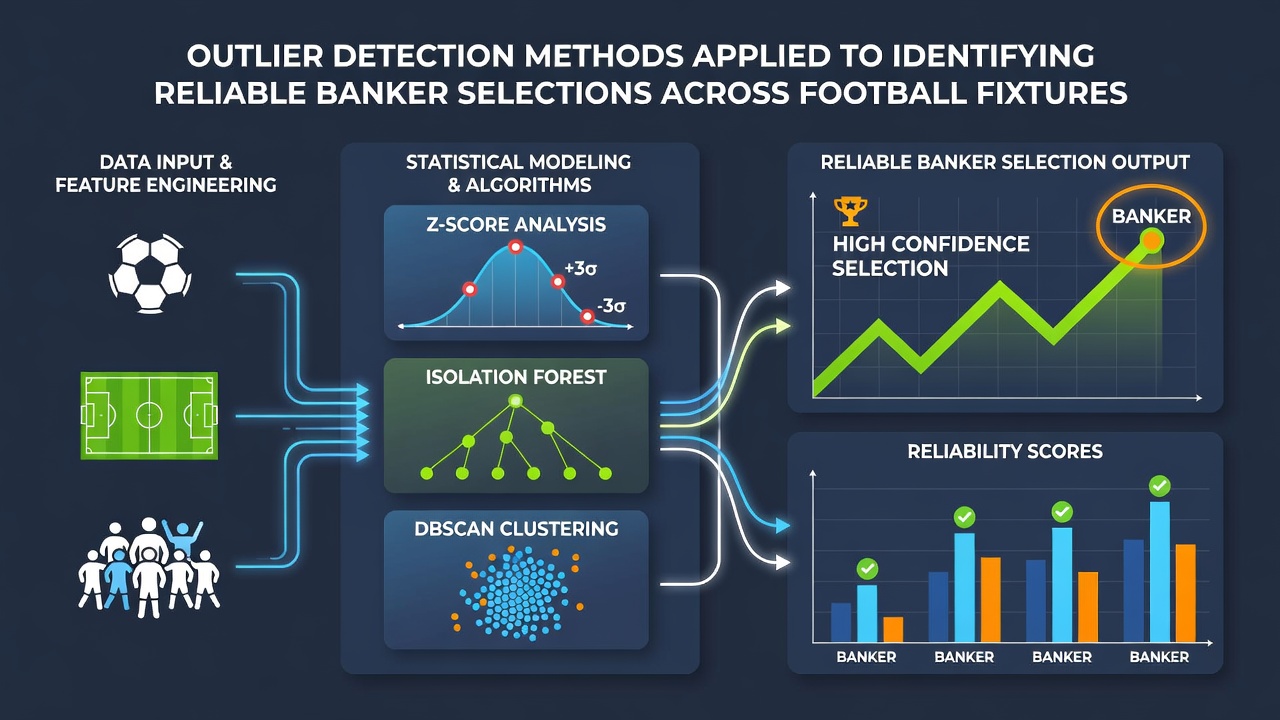
Analysts commonly deploy z-score calculations and interquartile range methods to highlight fixtures where results deviate sharply from expected distributions, yet still align with underlying strength indicators. A team posting an unusually high number of clean sheets against mid-table opponents, for instance, can register as an outlier that strengthens its status as a banker selection when cross-referenced with home advantage data. Isolation forest algorithms and DBSCAN clustering further separate genuine performance edges from random fluctuations, producing clusters that observers note tend to repeat across comparable fixtures in subsequent weeks.
Machine Learning Models for Fixture Analysis
Supervised and unsupervised learning frameworks process historical match files to detect outliers that correlate with high-probability banker outcomes. One study released by researchers at the University of Melbourne examined over 12,000 fixtures and found that local outlier factor scores improved banker identification accuracy by highlighting matches where defensive metrics sat outside typical ranges while offensive outputs remained stable. These models incorporate variables such as expected goals differentials, set-piece efficiency, and travel distance, allowing systems to flag selections where the outlier status points toward reliability rather than noise.
Practitioners who integrate multiple detection layers report that combining statistical thresholds with ensemble methods reduces false positives in banker lists. When a fixture registers as an outlier across both z-score and density-based scans, analysts often assign it higher weight in accumulator constructions because the convergence signals stronger underlying consistency. Figures released by the Canadian Sports Analytics Association in mid-2026 show increased adoption of these layered approaches among professional betting syndicates operating across international markets.
Application Across Different Leagues and Contexts
League-specific characteristics influence how outlier detection performs when applied to banker selections. In competitions with pronounced home dominance, such as certain South American divisions, distance-based clustering often surfaces fixtures where away underperformance creates clear outlier patterns that hold across multiple rounds. Conversely, in high-scoring environments like the Dutch Eredivisie, analysts adjust parameters to account for elevated variance before labeling any outcome as a reliable banker. Those who have studied these regional differences note that recalibrating detection thresholds per league improves long-term hit rates without introducing subjective adjustments.
Weather conditions, fixture congestion, and managerial changes also generate outliers that detection systems must contextualize. A sudden spike in red cards during congested schedules, for example, can appear anomalous until models incorporate rest-day differentials and historical disciplinary trends. Once adjusted, the same outlier may reinforce a banker selection for the opposing side rather than undermine it. Evidence from academic papers indexed on research repositories demonstrates that context-aware preprocessing steps raise the proportion of stable banker picks identified through automated pipelines.
Challenges and Refinement Techniques
Overfitting remains a persistent issue when models train on limited historical windows, leading some teams to implement rolling validation windows that span at least three full seasons. Feature engineering plays an equally important role, as raw goal counts alone rarely suffice, whereas derived metrics like non-penalty expected goals per 90 minutes produce more robust outlier signals. Observers note that successful implementations frequently pair detection outputs with human review stages to confirm that flagged anomalies align with qualitative factors such as key player availability and tactical shifts.
Real-time data feeds have accelerated the deployment of these methods, enabling updates between matchdays that capture late team news or pitch condition changes. In July 2026, several European data providers expanded their API offerings to include granular event streams, which in turn supports more frequent recalibration of outlier thresholds. The result is a feedback loop where new fixtures continuously refine the criteria used to designate reliable bankers.
Conclusion
Outlier detection methods continue to evolve as computational resources and data granularity increase, providing structured ways to surface reliable banker selections across football fixtures. By combining classical statistical tests with modern clustering and forest-based algorithms, analysts isolate patterns that demonstrate consistency over time while accounting for league-specific and situational variables. Continued refinement through rolling validation and context-aware feature sets suggests these techniques will remain central to systematic approaches in football analytics.